




At A Glance | |
Location | Davao de Oro Province, Southeastern Mindanao, Philippines |
Business activities | Proposed project is an open pit copper-gold mine that delivers ore to a 60,000 tpd mill facility and a 40,000 tpd heap leach facility. |
Deposit Type | Porphyry Copper-Gold Deposit |
Resource | Measured and Indicated Mineral Resources amount to 1.119B tonnes at 0.24% Cu and 0.34 g/t Au. Inferred Mineral Resources amount to 675.2M tonnes at 0.20% Cu and 0.27 g/t Au. |
Reserve | Reserves amenable to milling and leaching amount to 959.4M tonnes at 0.26% Cu and 0.36 g/t Au. |
Logistics | Approximately 90 km from Davao City, accessible through the Tagum-Mati National Road. |
Overview
The Kingking Copper-Gold Project (the “Kingking Project”) is located near Davao City, in Mindanao, Philippines. The mining rate will be approximately 178,000 tonnes per day (tpd) and over the life of the Kingking Project, 4.55 billion pounds of copper and 7.10 million ounces of gold are projected to be produced.
The proposed project is an open pit copper-gold mine that delivers ore to a 60,000 tpd mill facility and a 40,000 tpd heap leach facility. The mill facility treats the mill ore with primary crushing, grinding, flotation, tailing agitated leach (with Solvent Extraction and Electrowinning [SX-EW]), tailing neutralization followed by dry stack tailing placement. The heap leach facility treats the heap leach ore through tertiary crushing, agglomeration, placement on an on-off leach pad that produces pregnant leach solution (PLS) that will be processed in an SX-EW facility.
St. Augustine Gold & Copper Ltd. (“SAGC”) contracted M3 Engineering and Technology Corporation (“M3”) in Tucson, Arizona, to prepare a Preliminary Feasibility Study (the “PFS”) compliant with National Instrument 43-101 (“NI 43-101) on the Kingking Copper-Gold Project (the “Kingking Project”).
The Kingking Project is covered by an approved Declaration of Mining Project Feasibility (“DMPF”) and Environmental Compliance Certificate (“ECC”) issued by the Mines and Geosciences Bureau (“MGB”) and the Environmental Management Bureau (“EMB”), respectively, of the Department of Environment and Natural Resources (“DENR”) of the Republic of the Philippines.
LOCATION AND ACCESSIBILITY
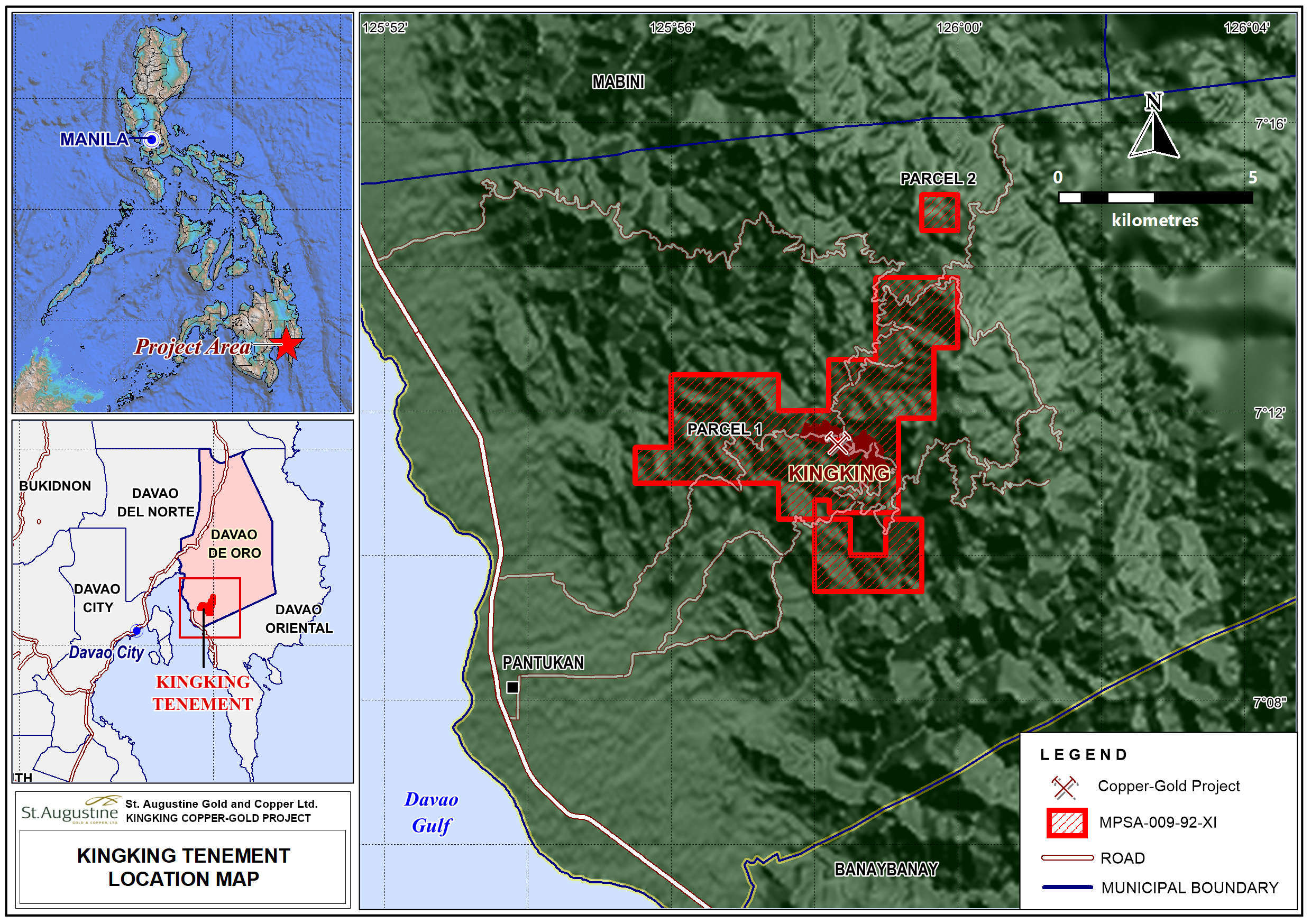
The Kingking Project is located on the eastern side of the Gulf of Davao, approximately 92 kilometers from Davao City, accessible through the Tagum-Mati National Road and 18 km northeast from Pantukan Town Proper via the Buko-Buko sa Anay Lawaan dirt road.
The Kingking mineral property area falls under Mineral Production Sharing Agreement No. 009-92-XI, Amended II. It covers Two Thousand Nine Hundred Seventy-Six and 71/100 (2976.071) hectares, located in Sitio Lahi, Barangay Magnaga, and Sitio Gumayan of Barangay Kingking, all within the Municipality of Pantukan, Davao De Oro province, on Mindanao Island. The tenement boundaries are defined by two parcels.
Geology
The Kingking Copper-Gold Project is a gold-rich porphyry copper deposit located in Davao de Oro on the island of Mindanao in the Philippines.
The Kingking deposit is a porphyry copper-gold deposit hosted primarily by porphyritic hornblende diorites, submarine volcanic rocks, and volcanoclastic sediments. The intrusive rocks are believed to be Miocene in age, while the volcanic wall rocks are Cretaceous to early Tertiary. Copper and gold mineralization occurs at or near the apex of the composite diorite intrusive complex within the intrusive rocks and extends well into the surrounding wall rocks.
The majority of the sulfide copper mineralization in the Kingking deposit consists of chalcopyrite and bornite, with lesser amounts of chalcocite, digenite, and covellite. Rapid regional uplift and erosion likely caused the nearly complete removal of a classical leached cap and eroded or prevented the development of typically thick oxide and supergene enriched zones such as those found in other major porphyry deposits. Copper mineralization in the oxide zone is observed in silicates and phosphates. Copper silicates are the most abundant oxide mineral group present, with copper silicates minerals containing MgO and FeO being the most prevalent of this group in the oxide zone.
Gold is relatively abundant in the oxide zone, in free form formerly in association with the original copper and iron sulfides before they oxidized. Gold also occurs in the sulfide zone of the deposit in free form in close association with bornite and as exsolution intergrowths in other sulfides, particularly pyrite and chalcopyrite. Native gold is occasionally observed on fractures and in quartz veinlets.
In general terms, the Kingking gold-copper deposit is consistent in type and form with other bulk-tonnage copper-gold porphyry deposits of the Philippines and elsewhere in the world. The deposit is low in pyrite, averaging less than one percent by volume FeS2. This is reflected by the relative absence of a pyrite halo that is commonly developed around many porphyry copper deposits. For process development purposes, two types of mineralization are considered: sulfide and oxide (which includes mixed oxide-sulfide material).
Exploration
Exploration of the Kingking deposit has spanned several decades and represents the efforts of numerous companies and individuals. A significant portion of past work focused on drilling to explore, define and confirm the economic potential of the property. The interpretation of the exploration work performed to date indicates that the Kingking deposit is a significant copper-gold porphyry system with the potential to become an economically profitable project. The drilling performed through 1998 (Echo Bay period) has also been used to develop an NI 43-101 compliant mineral resource for the deposit, as presented in Section 14 of the Technical Report.
Three companies completed exploration-level drilling campaigns on the Kingking property – Mitsubishi Metal Mining Corp. (Mitsubishi), Benguet Corporation (Benguet), and Echo Bay Mines Ltd. (Echo Bay). The database provided to Independent Mining Consultants (IMC) represents 276 drill holes totalling 89,922 meters of diamond core and reverse circulation (RC) holes.
In addition to this historic drilling, SAGC commissioned 14 holes in 2011: three holes (SAG-01 through SAG-03) designed to further evaluate local areas of the deposit for enhancements to mineral resource estimation (and for metallurgical testing), six holes (SAGT-01 through SAGT-06) to gather geotechnical data for pit slope design, one hole to provide samples for further metallurgical testing (SAM-01), and four holes to provide hydrogeologic data for open pit dewatering well design. The total depth of the 14 holes is 5,980 meters.
Estimates of mineralized tonnage and grade for the Kingking deposit have historically been based upon assays derived from drilled intercepts. Approximately 33,660 samples were collected over the course of the Kingking Project and processed by four separate analytical laboratories that include Benguet’s in-house laboratories at Dizon and Balatoc, McPhar Laboratory in Manila and Inchcape Laboratories in Manila. The sample preparation was completed by the companies previously working on the Kingking Project.
Sample preparation and analysis procedures for the Benguet, Echo Bay, and SAGC drilling campaigns were acceptable. Similar procedures for the Mitsubishi drilling program of 1969-1972 were not available for review, nor are the sample security procedures (chain of custody) known for this program. The chain of custody procedures employed by Echo Bay is believed to have been adequate.
Based on thorough review and analysis of the historic data, SAGC determined that three of five exploration drill holes situated in the Diat and Binutaan areas to the northeast of the planned open pit intersected favorable host lithologies and highly anomalous copper and gold values. With further exploration work (geophysics, soil and rock geochemistry, drilling), portions of this mineralization may prove to be economically extractible in separate open pits that would be satellite to the main Kingking pit.
Mineral Resource and Reserve
The Mineral Resources include Mineral Resources amenable to milling and flotation concentration methods (mill material) and Mineral Resources amenable to heap leach recovery methods (leach material).
Milling Measured and Indicated Mineral Resources amount to 1.03 billion tonnes at 0.24% total copper and 0.34 g/t gold for 5.55 billion pounds of contained copper and 11.1 million ounces contained gold. Inferred Mineral Resource is an additional 640.5 million tonnes at 0.20% total copper and 0.27 g/t gold for 2.85 billion pounds of contained copper and 5.46 million ounces of contained gold.
Leach material is oxide/mixed dominant mineralization. Measured and Indicated Mineral Resources amount to 85.0 million tonnes at 0.23% total copper and 0.15% soluble copper and contained metal amounts to 430.0 million pounds of copper. Gold is not recovered in the heap leach process. Inferred Mineral Resource is an additional 34.7 million tonnes at 0.21% total copper and 0.12% soluble copper and contained metal amounts to 159.0 million pounds of copper.
Table 1 presents the Milling and Leaching Mineral Resource for the Kingking Project. The Mineral Resource is based an updated block model developed by IMC during August 2023.
Table 1. Kingking Mineral Resource
Mineral Resource (Milling & Leaching) | Million Tonnes | NSR ($/t) | Tot Cu (%) | Sol Cu (%) | Gold (g/t) | Copper (Mlbs) | Gold (Koz) |
Measured/ | 1119.7 | 24.85 | 0.24 | 0.06 | 0.34 | 5,553 | 11,147 |
Inferred | 675.2 | 19.75 | 0.20 | 0.03 | 0.27 | 2,854 | 5,464 |
The Proven and Probable Mineral Reserves amenable to milling amount to 848.9 million tonnes at 0.26% total copper and 0.36 g/t gold for 4.84 billion pounds of contained copper and 9.77 million ounces of contained gold. The Proven and Probable Mineral Reserves amenable to heap leaching amounts to 110.5 million tonnes at 0.23% copper for 555 million pounds of contained copper.
Table 2 presents the milling and leaching Mineral Reserve estimate for the Kingking Project. There are Mineral Reserves amenable to milling and Mineral Reserves amenable to heap leaching.
Table 2. Kingking Mineral Reserve from Milling and Leaching
Mineral Reserve | Million Tonnes | NSR ($/t) | Tot Cu (%) | Sol Cu (%) | Gold (g/t) | Copper (Mlbs) | Gold (Koz) |
Proven/ | 959.4 | 25.95 | 0.26 | 0.06 | 0.36 | 5,396 | 9,771 |
Overview
The Kingking Copper-Gold Project (the “Kingking Project”) is located near Davao City, in Mindanao, Philippines. The mining rate will be approximately 178,000 tonnes per day (tpd) utilizing contract mining. Over the life of the Kingking Project, 4.55 billion pounds of copper and 7.10 million ounces of gold are projected to be produced.
The proposed project is an open pit copper-gold mine that delivers ore to a 60,000 tpd mill facility and a 40,000 tpd heap leach facility. The mill facility treats the mill ore with primary crushing, grinding, flotation, tailing agitated leach (with Solvent Extraction and Electrowinning [SX-EW]), tailing neutralization followed by dry stack tailing placement. The heap leach facility treats the heap leach ore with primary through tertiary crushing, agglomeration, placement on an on-off leach pad that produces pregnant leach solution (PLS) that will be processed in an SX-EW facility.
St. Augustine Gold & Copper Ltd. (“SAGC”) of Makati, Philippines, contracted M3 Engineering and Technology Corporation (“M3”) in Tucson, Arizona, to prepare a Preliminary Feasibility Study (the “PFS”) compliant with National Instrument 43-101 (“NI 43-101) on the Kingking Copper-Gold Project (the “Kingking Project”).
The Kingking Project is covered by an approved Declaration of Mining Project Feasibility (“DMPF”) and Environmental Compliance Certificate (“ECC”) issued by the Mines and Geosciences Bureau (“MGB”) and the Environmental Management Bureau (“EMB”), respectively, of the Department of Environment and Natural Resources (“DENR”) of the Republic of the Philippines.
Geology
The Kingking Copper-Gold Project is a gold-rich porphyry copper deposit located in Davao de Oro on the island of Mindanao in the Philippines.
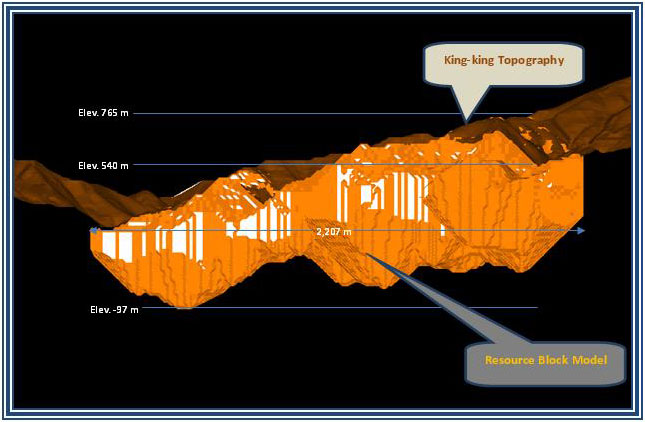
The Kingking deposit is a porphyry copper-gold deposit hosted primarily by porphyritic hornblende diorites, submarine volcanic rocks, and volcanoclastic sediments. The intrusive rocks are believed to be Miocene in age, while the volcanic wall rocks are Cretaceous to early Tertiary. Copper and gold mineralization occurs at or near the apex of the composite diorite intrusive complex within the intrusive rocks and extends well into the surrounding wall rocks.
The majority of the sulfide copper mineralization in the Kingking deposit consists of chalcopyrite and bornite, with lesser amounts of chalcocite, digenite, and covellite. Rapid regional uplift and erosion likely caused the nearly complete removal of a classical leached cap and eroded or prevented the development of typically thick oxide and supergene enriched zones such as those found in other major porphyry deposits. Copper mineralization in the oxide zone is observed in silicates and phosphates. Copper silicates are the most abundant oxide mineral group present, with copper silicates minerals containing MgO and FeO being the most prevalent of this group in the oxide zone.
Gold is relatively abundant in the oxide zone, in free form formerly in association with the original copper and iron sulfides before they oxidized. Gold also occurs in the sulfide zone of the deposit in free form in close association with bornite and as exsolution intergrowths in other sulfides, particularly pyrite and chalcopyrite. Native gold is occasionally observed on fractures and in quartz veinlets.
In general terms, the Kingking gold-copper deposit is consistent in type and form with other bulk-tonnage copper-gold porphyry deposits of the Philippines and elsewhere in the world. The deposit is low in pyrite, averaging less than one percent by volume FeS2. This is reflected by the relative absence of a pyrite halo that is commonly developed around many porphyry copper deposits. For process development purposes, two types of mineralization are considered: sulfide and oxide (which includes mixed oxide-sulfide material).

Exploration
Exploration of the Kingking deposit has spanned several decades and represents the efforts of numerous companies and individuals. A significant portion of past work focused on drilling to explore, define, and confirm the economic potential of the property. The interpretation of the exploration work performed to date indicates that the Kingking deposit is a significant copper-gold porphyry system with the potential to become an economically profitable project. The drilling performed through 1998 (Echo Bay period) has also been used to develop an NI 43-101 compliant mineral resource for the deposit, as presented in Section 14 of the Technical Report.
Three companies completed exploration-level drilling campaigns on the Kingking property – Mitsubishi Metal Mining Corp. (Mitsubishi), Benguet Corporation (Benguet), and Echo Bay Mines Ltd. (Echo Bay). The database provided to Independent Mining Consultants (IMC) represents 276 drill holes totalling 89,922 meters of diamond core and reverse circulation (RC) holes.
In addition to this historic drilling, SAGC commissioned 14 holes in 2011: three holes (SAG-01 through SAG-03) designed to further evaluate local areas of the deposit for enhancements to mineral resource estimation (and for metallurgical testing), six holes (SAGT-01 through SAGT-06) to gather geotechnical data for pit slope design, one hole to provide samples for further metallurgical testing (SAM-01), and four holes to provide hydrogeologic data for open pit dewatering well design. The total depth of the 14 holes is 5,980 meters.
Estimates of mineralized tonnage and grade for the Kingking deposit have historically been based upon assays derived from drilled intercepts. Approximately 33,660 samples were collected over the course of the Kingking Project and processed by four separate analytical laboratories that include Benguet’s in-house laboratories at Dizon and Balatoc, McPhar Laboratory in Manila and Inchcape Laboratories in Manila. The sample preparation was completed by the companies previously working on the Kingking Project.
Sample preparation and analysis procedures for the Benguet, Echo Bay, and SAGC drilling campaigns were acceptable. Similar procedures for the Mitsubishi drilling program of 1969-1972 were not available for review, nor are the sample security procedures (chain of custody) known for this program. The chain of custody procedures employed by Echo Bay is believed to have been adequate.
Based on thorough review and analysis of the historic data, SAGC determined that three of five exploration drill holes situated in the Diat and Binutaan areas to the northeast of the planned open pit intersected favorable host lithologies and highly anomalous copper and gold values. With further exploration work (geophysics, soil and rock geochemistry, drilling), portions of this mineralization may prove to be economically extractible in separate open pits that would be satellite to the main Kingking pit.
Mineral Resource and Probable Mineral Reserve
Table 1. Kingking Mineral Resource
Mineral Resource (Milling & Leaching)
Million Tonnes
NSR ($/t)
Tot Cu (%)
Sol Cu (%)
Gold (g/t)
Copper (Mlbs)
Gold (Koz)
Measured/ Indicated
1119.7
24.85
0.24
0.06
0.34
5,553
11,147
Inferred
675.2
19.75
0.20
0.03
0.27
2,854
5,464
The Proven and Probable Mineral Reserve amenable to milling amount to 848.9 million tonnes at 0.26% total copper and 0.36 g/t gold for 4.84 billion pounds of contained copper and 9.77 million ounces of contained gold. The Proven and Probable Mineral Reserve amenable to heap leaching amounts to 110.5 million tonnes at 0.23% copper for 555 million pounds of contained copper.
Table 2 presents the Mineral Reserve estimate for the Kingking Project. There are Mineral Reserves amenable to milling and Mineral Reserves amenable to heap leaching.
Table 2. Kingking Mineral Reserve from Milling and Leaching
Mineral Reserve
Million Tonnes
NSR ($/t)
Tot Cu (%)
Sol Cu (%)
Gold (g/t)
Copper (Mlbs)
Gold (Koz)
Proven/Probable
959.4
25.95
0.26
0.06
0.36
5,396
9,771
Highlights of Project Economics and Key Parameters
Mine Life
38 years
After-tax NPV @ 7%
$4.18 Billion
IRR
34.20%
Payback Period
1.9 years
CAPEX
$3.17 Billion
composed of $2.37B Initial
Capex and $798 Sustaining
Capex
Strip Ratio (LOM)
0.81
The Kingking tenement covers 2,976 hectares within the Municipality of Pantukan, Province of Davao de Oro. The Mineral Production Sharing Agreement #009-92-XI (the MPSA) was approved by the Government of the Philippines on May 27, 1992, and amended December 11, 2002. The MPSA grants the exclusive right to explore, develop and exploit minerals within the area comprising the Kingking deposit.The project is listed as one of the top priority projects by the Philippine Mines and Geosciences Bureau and it is a gold-rich porphyry copper deposit spatially related to significant epithermal vein systems that can be potentially exploited by open pit mining methods to produce economic concentrations of gold and copper.
The table below presents the mineral reserve for the Kingking Project based on the mine and plant production schedules developed for the feasibility study. The mineral reserve amounts to 959.4M tonnes at 0.26% total copper and 0.36 g/t gold.
| Mineral Reserve (Milling): | Tonnes | NSR | Tot Cu | Sol Cu | Gold | Copper | Gold |
| Mt | ($/t) | (%) | (%) | (g/t) | (Mlbs) | (Koz) | |
| Proven Mineral Reserve | 142.3 | 37.83 | 0.33 | 0.12 | 0.49 | 1,037 | 2,253 |
| Oxide Mill Ore | 45.4 | 58.56 | 0.52 | 0.30 | 0.71 | 516 | 1,033 |
| Sulfide Mill Ore | 76.5 | 31.90 | 0.26 | 0.04 | 0.45 | 444 | 1,117 |
| Low Grade Stockpile | 20.4 | 13.93 | 0.17 | 0.02 | 0.16 | 78 | 103 |
| Probable Mineral Reserve | 706.5 | 25.51 | 0.24 | 0.04 | 0.33 | 3,803 | 7,519 |
| Oxide Mill Ore | 52.0 | 43.46 | 0.36 | 0.21 | 0.59 | 412 | 986 |
| Sulfide Mill Ore | 499.7 | 27.08 | 0.25 | 0.03 | 0.36 | 2,776 | 5,751 |
| Low Grade Stockpile | 154.9 | 14.43 | 0.18 | 0.02 | 0.16 | 615 | 782 |
| Proven/Probable Reserve: | 848.9 | 27.57 | 0.26 | 0.06 | 0.36 | 4,840 | 9,771 |
| Oxide Mill Ore | 97.4 | 50.50 | 0.43 | 0.25 | 0.64 | 928 | 2,018 |
| Sulfide Mill Ore | 576.2 | 27.72 | 0.25 | 0.03 | 0.37 | 3,220 | 6,868 |
| Low Grade Stockpile | 175.3 | 14.37 | 0.18 | 0.02 | 0.16 | 692 | 885 |
| Mineral Reserve (Leaching): | Tonnes | NSR | Tot Cu | Sol Cu | Gold | Copper | Gold |
| Mt | ($/t) | (%) | (%) | (g/t) | (Mlbs) | (Koz) | |
| Proven Mineral Reserve | 50.2 | 14.97 | 0.25 | 0.16 | N.A. | 275 | N.A. |
| Proven Mineral Reserve | 60.4 | 12.22 | 0.21 | 0.12 | N.A | 280 | N.A |
| Prov/Prob Leach Reserve | 110.5 | 13.47 | 0.23 | 0.14 | N.A | 555 | N.A |
| Copper Mineral Reserve | Tonnes | NSR | Tot Cu | Sol Cu | Gold | Copper | Gold |
| Milling and Leaching | Mt | ($/t) | (%) | (%) | (g/t) | (Mlbs) | (Koz) |
| Proven/Probable Reserve | 959.4 | 25.95 | 0.26 | 0.06 | N.A. | 5,396 | N.A. |
| Proven Mineral Reserve | 192.5 | 31.87 | 0.31 | 0.13 | N.A | 1,312 | N.A |
| Probable Mineral Reserve | 766.9 | 24.46 | 0.24 | 0.05 | N.A | 4,083 | N.A |
Production
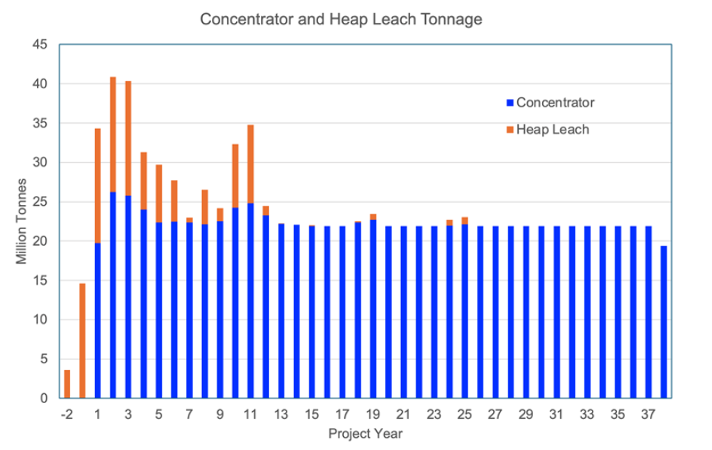
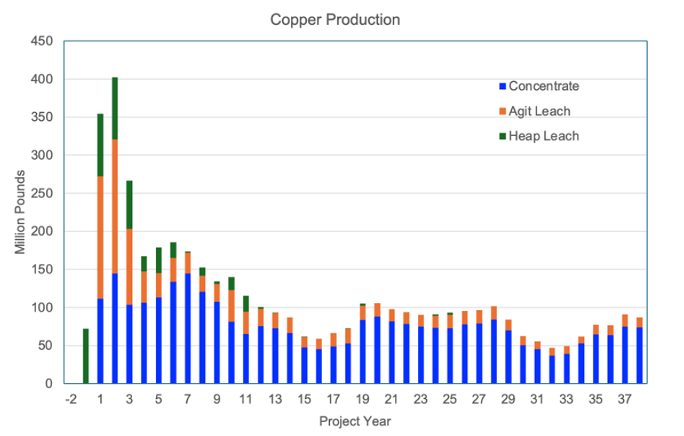
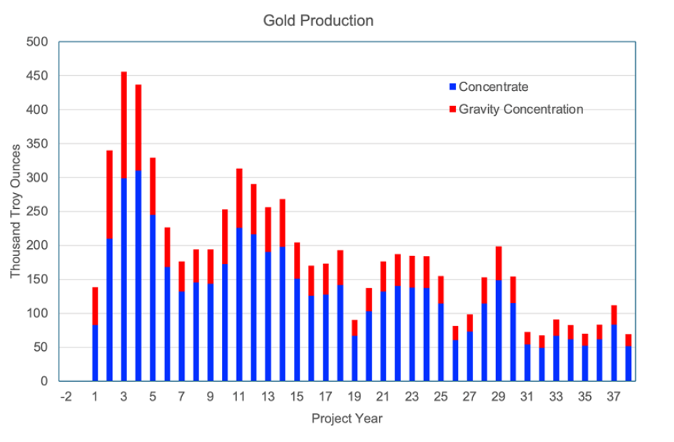
Production statistics are graphically illustrated on the left *. The higher copper and gold production rates occur early in the project, which enhance project economics and reduce the payback period. The higher rates are due to:
- Higher ore throughputs for both the mill and heap leach
- Higher mill ore copper and gold grades
- Higher copper recoveries at the mill and heap leach
*Click on each graph to enlarge.
Mining Schedule & Development Process
First 5 Years
Life of Mine
Processed Tonnes
Mill
96 million*
849 million
Heap Leach
69 million
111 million
Copper (%)
Mill
0.49
0.26
Heap Leach
0.26
0.23
Gold (g/tonne)
Mill
0.67
0.36
Waste to Ore Ratio
0.54
0.87
The proposed open-pit mine will produce copper / gold concentrate, copper cathode, and gold doré bullion. On average, the mine will annually produce:
120 million pounds of copper
186 thousand ounces of gold
Oxide ore containing significant gold and all sulfide ore will be treated in a concentrator at 60,000 tpd. The concentrator process will consist of crushing, grinding, gravity concentration of free gold, and flotation of sulfide copper. An agitated leach circuit will leach oxide copper from flotation tails. Oxide ore containing little or no gold will be treated in a heap leach at 40,000 tpd. The heap leach process will consist of crushing, agglomeration, and leaching utilizing on-off cells.